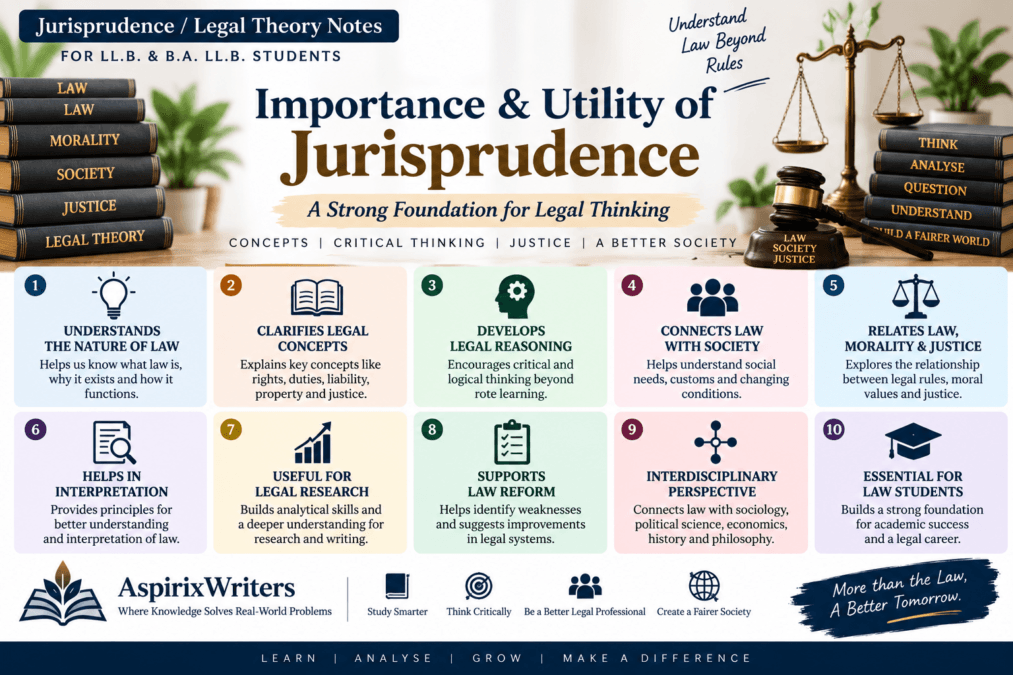

Jurisprudence and Legal Philosophy
Introduction
Jurisprudence and Legal Philosophy are closely related fields concerned with the fundamental and philosophical questions surrounding law.
Jurisprudence studies the nature, meaning, principles and concepts of law, while Legal Philosophy examines law through deeper philosophical questions concerning justice, morality, rights, obligation, authority and the purpose of law.
Modern jurisprudence courses commonly examine questions such as What is law?, What is the relationship between law and morality?, Why should law be obeyed? and What is justice?
Don’t Miss New Law Opportunities!
Join our WhatsApp community for verified updates on Law Jobs, Internships, Competitions, Scholarships, LLB Notes & more.
1. What is Jurisprudence?
Jurisprudence is the systematic and theoretical study of law.
It deals with fundamental questions relating to:
- Nature and meaning of law
- Sources of law
- Legal concepts
- Rights and duties
- Possession and ownership
- Liability and obligation
- Justice
- Law and morality
- Schools of jurisprudence
- Relationship between law and society
In the University of Rajasthan’s current LL.B. syllabus, Jurisprudence includes the definition, nature, scope and importance of jurisprudence, schools of jurisprudence, sources of law and fundamental legal concepts.
2. What is Legal Philosophy?
Legal Philosophy is the philosophical study of law.
It asks deeper questions about the meaning, justification, authority and moral dimensions of law.
Important questions include:
- What is the nature of law?
- What makes a law valid?
- Is law necessarily connected with morality?
- Why should citizens obey the law?
- What makes a law just?
- What rights should individuals have?
- What is the proper relationship between law and justice?
The University of Delhi describes Legal Philosophy as a branch of philosophy and jurisprudence concerned with the general and fundamental study of law and legal systems.
3. Relationship Between Jurisprudence and Legal Philosophy
Jurisprudence and Legal Philosophy have substantial overlap.
Legal Philosophy provides a philosophical method of thinking about law, while jurisprudence provides a broader systematic study of the fundamental aspects of law.
Their relationship can be understood through five major areas:
1. Nature of Law
Both examine what law is and what makes a rule legally valid.
2. Law and Morality
Both consider whether legal validity depends upon morality.
3. Justice
Both examine the meaning and foundations of justice.
4. Legal Obligation
Both ask why individuals should obey law.
5. Rights and Freedom
Both examine fundamental questions concerning rights, liberty and equality.
NLSIU’s jurisprudence curriculum specifically connects the philosophical study of law with morality, legal obligation and theories of justice.
4. Difference Between Jurisprudence and Legal Philosophy
The two terms are closely connected, but a general distinction can be made for students.
| Basis | Jurisprudence | Legal Philosophy |
| Meaning | Systematic and theoretical study of law. | Philosophical examination of fundamental questions about law. |
| Nature | Broader field of theoretical legal study. | More specifically philosophical in approach. |
| Focus | Law, legal concepts, schools, sources, justice, morality and legal institutions. | Fundamental questions concerning law, morality, justice, rights, authority and obligation. |
| Approach | May be analytical, historical, sociological, realist, philosophical, economic, feminist, etc. | Primarily philosophical, conceptual and normative. |
| Main Question | What is law and how can law be understood? | What is law, why is it authoritative, and what makes law just or legitimate? |
| Scope | Can extend to many areas of legal thought and concepts. | Concentrates more strongly on philosophical foundations of law. |
| Relationship | Broader systematic study of fundamental legal ideas. | An important philosophical dimension of jurisprudence. |
Important Note
This distinction should not be treated as absolute.
Different universities and scholars use the terms differently. NLSIU, for example, describes its Jurisprudence course as an introduction to the philosophy of law, while the University of Delhi describes Legal Philosophy as a branch of philosophy and jurisprudence.
Therefore:
Legal Philosophy can be understood as a philosophical dimension of Jurisprudence, while Jurisprudence is generally the broader systematic study of fundamental questions concerning law.
5. Major Philosophical Questions in Jurisprudence
Legal philosophy is concerned with some of the most fundamental questions of legal thought.
What is Law?
Different schools provide different answers.
For example:
- Natural Law connects law with morality and reason.
- Legal Positivism focuses on law as a social and institutional fact.
- Legal Realism emphasises the practical operation of law.
Is Law Connected with Morality?
This is one of the central debates in jurisprudence.
The debate is particularly associated with thinkers such as H.L.A. Hart and Lon Fuller.
What is Justice?
Legal philosophy examines different conceptions of justice, including:
- Distributive Justice
- Corrective Justice
- Social Justice
- Procedural Justice
Why Should Law Be Obeyed?
This concerns the philosophical basis of legal obligation and authority.
How Should Judges Decide Difficult Cases?
This raises questions about:
- Rules
- Principles
- Interpretation
- Judicial discretion
- Rights
Contemporary jurisprudence examines these issues through debates involving thinkers such as Hart and Ronald Dworkin.
6. Important Thinkers in Legal Philosophy
| Thinker | Important Contribution |
| Plato | Ideas concerning justice and the ideal state |
| Aristotle | Justice and classification of justice |
| Thomas Aquinas | Natural Law |
| Thomas Hobbes | Social contract and political authority |
| John Locke | Natural rights and social contract |
| Jean-Jacques Rousseau | Social contract and political legitimacy |
| Jeremy Bentham | Utilitarianism |
| John Austin | Analytical positivism |
| Hans Kelsen | Pure Theory of Law |
| H.L.A. Hart | Modern legal positivism |
| Lon Fuller | Morality of law |
| Ronald Dworkin | Rights, principles and law as integrity |
| John Rawls | Theory of Justice |
7. Major Approaches to Legal Philosophy
1. Natural Law
Natural Law theories generally maintain that law has a relationship with morality, reason or principles of justice.
2. Legal Positivism
Legal Positivism generally distinguishes the existence or validity of law from its moral merit.
3. Utilitarianism
Associated particularly with Jeremy Bentham, utilitarianism evaluates legal and social arrangements by reference to their consequences and overall welfare.
4. Historical Approach
The Historical School emphasises the historical development of law and the role of social traditions.
5. Sociological Approach
Sociological jurisprudence examines law in relation to society and social interests.
6. Realism
Legal Realism focuses on how law operates in practice, including the role of judges and institutions.
7. Contemporary Critical Approaches
Modern legal philosophy also includes approaches such as:
- Critical Legal Studies
- Feminist Jurisprudence
- Law and Economics
- Rights-based theories
- Contemporary theories of justice
Current jurisprudence courses increasingly engage with these modern theoretical debates.
8. Why is Legal Philosophy Important for Law Students?
Legal Philosophy helps students:
- understand the foundations of law;
- develop critical thinking;
- analyse legal principles;
- understand different theories of law;
- examine law and morality;
- understand theories of justice;
- improve legal reasoning;
- critically evaluate legal institutions;
- understand difficult legal problems from different perspectives.
It helps transform legal education from memorising legal rules to understanding the ideas behind those rules.
Quick Revision
Jurisprudence
Systematic and theoretical study of law and its fundamental concepts.
Legal Philosophy
Philosophical study of the fundamental questions concerning law, morality, justice, rights and authority.
Relationship
Legal Philosophy is closely connected with and can be understood as an important philosophical dimension of Jurisprudence.
Easy Memory Trick
JURISPRUDENCE → STUDY OF LAW
LEGAL PHILOSOPHY → PHILOSOPHICAL QUESTIONS ABOUT LAW
Exam-Oriented Questions
- What is Jurisprudence?
- What is Legal Philosophy?
- Explain the relationship between Jurisprudence and Legal Philosophy.
- Distinguish between Jurisprudence and Legal Philosophy.
- Is Legal Philosophy a branch of Jurisprudence? Discuss.
- Explain the role of philosophy in the study of law.
- Discuss the relationship between law, morality and justice.
- Why is Legal Philosophy important for law students?
Key Takeaway
Jurisprudence and Legal Philosophy both encourage us to look beyond the text of legal rules and examine the deeper foundations of law.
Jurisprudence provides a systematic study of fundamental legal ideas, while Legal Philosophy focuses particularly on the philosophical questions of law, morality, justice, rights, authority and obligation.
Jurisprudence asks us to understand law; Legal Philosophy encourages us to question, examine and justify the foundations of law.
About the Author: Dr. Rekha Khandelwal is a legal researcher, academic writing expert, author and Founder of AspirixWriters, helping students and researchers understand complex legal and academic concepts in simple language. View Author Profile – Dr. Rekha Khandelwal
- Meaning & Definition of Jurisprudence
- Nature of Jurisprudence
- Scope of Jurisprudence
- Classification of Jurisprudence
- Importance & Utility of Jurisprudence
- Functions of Jurisprudence
- Jurisprudence & Legal Theory
- Main Jurisprudence / Legal Theory Notes pillar page
Classmate Pulse Spiral Notebook ✏️ Need a Spiral Notebook for Everyday Writing? A spiral notebook…

Latest Scholarships & Fellowships 2026–27: Open Opportunities for Upcoming call
Latest Scholarships & Research Fellowships 2026–27 Last Verified: 30 September 2026 Students, researchers, PhD scholars…
Writing & Research Resources: Useful Books, Tools & Essentials for Writers and Researchers
Whether you are an author, content writer, law student, academic researcher, PhD scholar, teacher, or…