Natural Law School in Jurisprudence/ Natural Law Theory
Unit 2: Schools of Jurisprudence
Introduction
The Natural Law School in Jurisprudence is one of the oldest and most influential schools of jurisprudence. It attempts to explain law not merely as a command of the State or a rule enforced by authority, but in relation to reason, morality, justice, nature and fundamental human values.
The central idea of Natural Law is that there are certain principles of right and wrong that are not created solely by the State. These principles may be derived from nature, reason, morality, religion or the inherent dignity of human beings, depending upon the particular thinker and historical period.
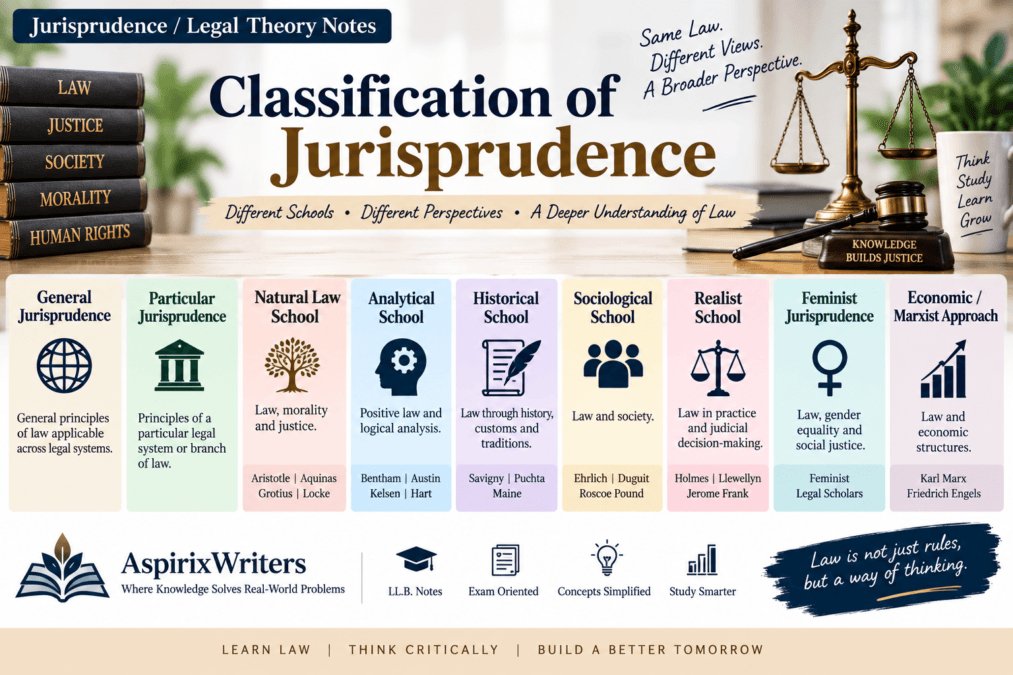
Natural Law theory has developed significantly over time. Its history is commonly studied through ancient, medieval, Renaissance/early modern and modern developments, for example Natural Law into the Ancient and Medieval Period, Renaissance Period, and Modern Period including the nineteenth, twentieth and post-Independence period.
Don’t Miss New Law Opportunities!
Join our WhatsApp community for verified updates on Law Jobs, Internships, Competitions, Scholarships, LLB Notes & more.
1. Meaning of Natural Law
The term Natural Law refers to principles of law or justice believed to arise from nature, reason, morality or fundamental human values, rather than merely from legislation or governmental command.
In simple words:
Natural Law means principles of right and justice that are considered higher than or independent of enacted law.
The exact meaning has changed from one historical period to another.
For example:
- Ancient thinkers often connected natural law with nature and reason.
- Medieval thinkers connected it strongly with God and divine order.
- Renaissance and early modern thinkers increasingly connected it with reason, human nature and natural rights.
- Modern theories revived Natural Law through ideas of human dignity, justice, fundamental rights and moral principles.
Therefore, Natural Law is not one single theory with one fixed definition.
2. Basic Idea of Natural Law
The basic proposition can be expressed as:
Law + Reason + Morality + Justice
Natural Law asks questions such as:
- What makes a law just?
- Is every enacted law morally legitimate?
- Are there principles of justice above State-made law?
- Can an extremely unjust law be considered a valid law?
- What is the relationship between law and morality?
- Are certain rights inherent in human beings?
These questions continue to be important in contemporary jurisprudence. Current jurisprudence courses at NLSIU, for example, examine the relationship between law and morality, legal obligation and justice, alongside debates involving Natural Law and Legal Positivism.
3. Main Characteristics of Natural Law
3.1 Higher Law
Natural Law generally assumes that there are principles of justice or morality that stand above ordinary enacted law.
Such principles may be described as:
- higher law
- universal principles
- moral principles
- principles of justice
3.2 Connection Between Law and Morality
Natural Law strongly emphasizes the relationship between law and morality.
According to the Natural Law tradition, the moral quality of law cannot always be ignored when evaluating law.
This distinguishes Natural Law from theories that insist upon a strict conceptual separation between the existence of law and its moral merit.
3.3 Importance of Reason
Reason has played an important role in many versions of Natural Law.
Human beings are considered capable of using reason to identify principles of justice and appropriate conduct.
3.4 Universal Character
Many Natural Law theories seek principles that have a universal application, although different thinkers have disagreed about what those principles are.
3.5 Justice as an Important Value
Natural Law gives considerable importance to justice.
A legal system is not evaluated solely by whether rules have been formally enacted; its relationship with justice and fundamental values is also considered.
3.6 Human Rights and Human Dignity
Modern Natural Law thinking has contributed to discussions concerning:
- human rights
- liberty
- equality
- dignity
- justice
- fundamental freedoms
3.7 Critical Evaluation of Positive Law
Natural Law provides a basis for asking whether enacted law is just, reasonable or morally defensible.
Therefore, it can serve as a critical standard for evaluating positive law.
4. Natural Law and Positive Law
A basic distinction in jurisprudence is between:
Natural Law
Principles based on:
- nature
- reason
- morality
- justice
- fundamental human values
Positive Law
Law that is actually laid down, recognized or enforced within a particular legal system.
The distinction can be remembered as:
Natural Law asks: “What should law be?”
Positive Law asks: “What is law within the legal system?”
However, this should not be understood too rigidly. Modern jurisprudence contains sophisticated debates about the relationship between legal validity and morality.
5. Historical Development of Natural Law
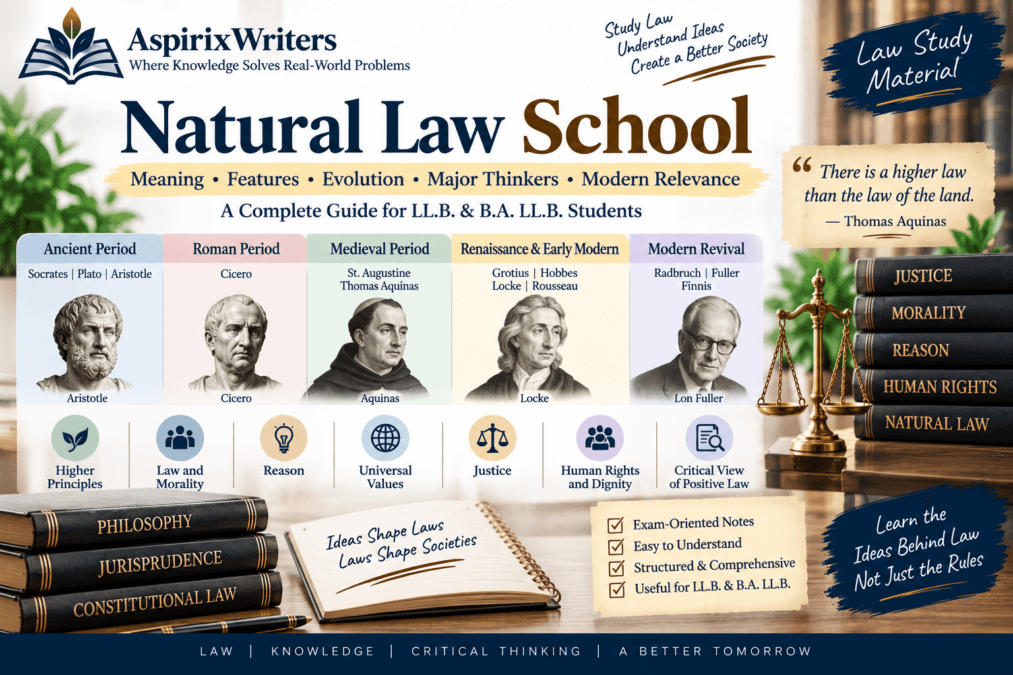
The development of Natural Law can be studied through several periods.
Major stages
- Ancient Greek Period
- Roman Period
- Medieval Period
- Renaissance and Early Modern Period
- Nineteenth-Century Decline
- Twentieth-Century Revival
- Contemporary and Post-Independence Relevance
This periodization is consistent with the historical treatment of Natural Law found in major jurisprudence materials and university curricula.
6. Ancient Natural Law
6.1 Greek Thinkers
Ancient Greek philosophy provided important foundations for Natural Law thinking.
Socrates
Socrates emphasized:
- moral knowledge
- virtue
- justice
- rational inquiry
He encouraged individuals to examine the principles underlying human conduct rather than simply accepting conventional practices.
6.2 Plato
Plato connected law and justice with a broader conception of the good and the proper ordering of society.
His philosophical approach influenced later thinking about justice and the relationship between law and moral values.
6.3 Aristotle
Aristotle distinguished between different forms of justice and discussed the idea that some principles of justice may have a basis beyond particular enacted rules.
His distinction between natural justice and legal justice became influential in the development of Natural Law thought.
Exam Point
Aristotle is an important ancient thinker associated with the idea of natural justice.
7. Roman Natural Law
Roman thinkers developed Natural Law ideas further.
Cicero
Marcus Tullius Cicero is one of the most important Roman thinkers associated with Natural Law.
He connected natural law with:
- reason
- nature
- universal justice
- human beings
The Roman contribution was significant because Natural Law became increasingly associated with the idea of a universal rational order.
Exam Memory
Cicero → Reason + Nature + Universal Law
8. Medieval Natural Law
During the medieval period, Natural Law became closely associated with Christian theology.
Important thinkers included:
- St. Augustine
- Thomas Aquinas
8.1 St. Augustine
St. Augustine connected law with divine order and morality.
His thought emphasized that human law should be consistent with higher moral and divine principles.
9. Thomas Aquinas and Natural Law
Thomas Aquinas is one of the most important thinkers in the history of Natural Law.
His theory developed within a theological framework.
Aquinas discussed different forms of law, particularly:
- Eternal Law
- Divine Law
- Natural Law
- Human Law
9.1 Eternal Law
Eternal Law represents the rational ordering of the universe according to divine wisdom.
9.2 Divine Law
Divine Law refers to law revealed through divine revelation.
9.3 Natural Law
Natural Law represents the participation of rational creatures in the eternal law.
Human beings can understand fundamental principles of right conduct through reason.
9.4 Human Law
Human Law consists of rules formulated by human authorities for governing society.
According to the Thomistic framework, human law should be directed toward the common good and should be consistent with higher principles of justice.
Exam Memory
Aquinas = Eternal + Divine + Natural + Human Law
Aquinas is therefore one of the most important names to remember for questions on Medieval Natural Law.
10. Renaissance and Early Modern Natural Law
The Renaissance and early modern period brought significant changes to Natural Law theory.
The emphasis gradually moved away from an exclusively theological explanation toward:
- human reason
- individual freedom
- natural rights
- consent
- political authority
- social contract
Important thinkers include:
- Thomas Hobbes
- John Locke
- Jean-Jacques Rousseau
- Hugo Grotius
11. Hugo Grotius
Hugo Grotius is an important figure in the development of modern Natural Law theory.
He emphasized reason and human sociality and contributed significantly to the development of modern legal thought, including the intellectual foundations of international law.
Key Point
Grotius represents the movement toward a more rational and secular formulation of Natural Law.
12. Thomas Hobbes
Hobbes explained Natural Law in the context of human nature, reason and the need for peace and security.
His political theory is closely associated with the social contract.
According to Hobbes, individuals in a state of nature face insecurity, and political authority becomes necessary for maintaining peace.
Key Concepts
Hobbes → Human Nature + Security + Social Contract
13. John Locke
John Locke developed Natural Rights theory around ideas including:
- life
- liberty
- property
He argued that government exists to protect fundamental rights and that political authority is connected with consent.
Locke’s ideas became highly influential in modern constitutionalism and rights-based political thought.
Exam Memory
Locke → Natural Rights → Life, Liberty and Property
14. Jean-Jacques Rousseau
Rousseau is associated with the idea of the social contract and popular sovereignty.
His famous concept of the general will became important in political and legal philosophy.
Rousseau’s work contributed to the development of modern thinking about:
- freedom
- equality
- political legitimacy
- popular sovereignty
15. Decline of Classical Natural Law
Natural Law enjoyed enormous influence for centuries, but its dominance declined during the nineteenth century.
Several factors contributed to this decline:
1. Rise of Legal Positivism
Thinkers such as Jeremy Bentham and John Austin emphasized positive law and the importance of identifying law as it exists within a legal system.
2. Rise of Historical Jurisprudence
Historical thinkers emphasized the historical development of law, custom and social institutions.
3. Scientific and Empirical Approaches
Nineteenth-century intellectual thought increasingly emphasized systematic, scientific and empirical methods.
4. Ambiguity of Natural Law
Critics argued that different thinkers could claim different principles as “natural,” raising questions about the objective identification of Natural Law.
16. Revival of Natural Law
Natural Law did not disappear permanently.
It experienced a revival during the twentieth century.
The revival was influenced by concerns about:
- totalitarianism
- human rights
- justice
- dignity
- morality
- limits on State power
The twentieth-century revival is particularly important because it brought Natural Law back into contemporary debates concerning the relationship between law and morality.
Major twentieth-century Natural Law thinkers include:
- Gustav Radbruch
- Lon L. Fuller
- John Finnis
17. Gustav Radbruch
Gustav Radbruch is associated with the idea that extreme injustice creates a serious challenge to the claim that enacted law should always be treated as law in the strongest sense.
His post-war jurisprudence became particularly important in discussions concerning the relationship between legal validity and extreme injustice.
Key Idea
Radbruch → Law and Justice + Problem of Extreme Injustice
18. Lon L. Fuller
Lon L. Fuller emphasized the internal morality of law.
He argued that a legal system must satisfy certain procedural principles if it is to function as a genuine system of law.
His famous principles include requirements concerning:
- generality
- publicity
- prospectivity
- clarity
- consistency
- practicability
- stability
- congruence between official action and declared rules
Exam Memory
Fuller → Internal Morality of Law
19. John Finnis
John Finnis represents an important contemporary Natural Law approach.
His work connects Natural Law with:
- practical reason
- basic human goods
- morality
- justice
- common good
Finnis’s work is an important part of contemporary Natural Law theory.
20. Natural Law and Human Rights
One of the most important modern contributions of Natural Law thinking is its relationship with human rights.
The idea that human beings possess certain fundamental rights simply because they are human has strong intellectual connections with natural-rights traditions.
These ideas have influenced debates concerning:
- dignity
- equality
- liberty
- freedom
- constitutional rights
- international human rights
However, human rights law should not be treated as identical to Natural Law. Modern human-rights systems have their own legal foundations through constitutions, treaties and other recognized legal instruments.
21. Natural Law and the Indian Legal Context
Natural Law is relevant to Indian legal thought particularly through constitutional values such as:
- justice
- liberty
- equality
- dignity
- fundamental rights
- constitutional morality
Indian constitutional adjudication frequently involves questions that require courts to reason about values, rights and justice.
However, Indian constitutional law should not simply be described as a Natural Law system. It is a constitutional legal system based on enacted constitutional text, legislation, precedent and other recognized sources, while courts may also engage with principles and values in interpreting these sources.
Therefore, the relationship is best understood as:
Natural Law provides a jurisprudential perspective for thinking about justice, rights and morality; Indian constitutional law applies these questions within the framework of the Constitution and the legal system.
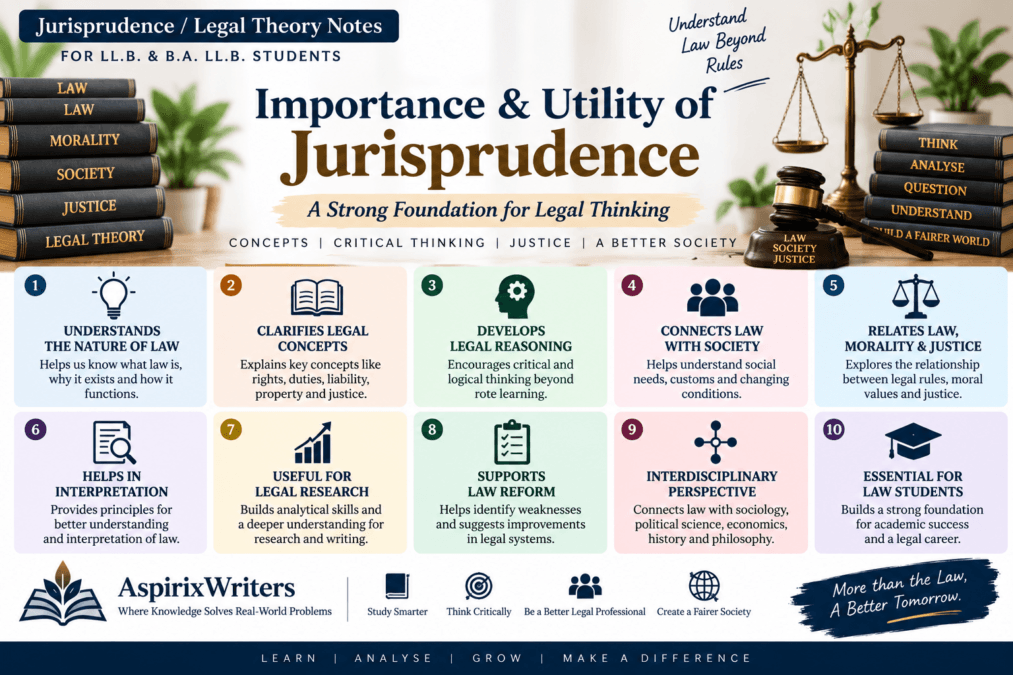
22. Importance of Natural Law Theory
Natural Law remains important because it provides a framework for critically examining law.
1. Law and Morality
It encourages examination of the relationship between legal rules and moral principles.
2. Justice
It emphasizes justice as an important standard for evaluating law.
3. Human Rights
Natural-rights thinking has contributed to discussions about fundamental human rights.
4. Limitation on State Power
It can provide a theoretical basis for questioning excessive or unjust State authority.
5. Constitutional Values
Natural Law perspectives can help students understand debates concerning liberty, equality, dignity and justice.
6. Critical Legal Thinking
It encourages students to ask not only:
“What is the law?”
but also:
“Is the law just?”
23. Criticism of Natural Law Theory
Natural Law has also faced significant criticism.
23.1 Lack of Clear Definition
Different thinkers have given different meanings to:
- nature
- reason
- morality
- justice
- natural rights
Therefore, identifying one universally accepted Natural Law can be difficult.
23.2 Subjectivity
Critics argue that people may disagree about what morality or natural justice requires.
23.3 Difficulty in Application
Even if a higher moral principle exists, applying it to concrete legal disputes may be difficult.
23.4 Conflict Between Moral Values
Different societies and individuals may hold different moral values.
This creates difficulties in identifying universally accepted principles.
23.5 Positivist Criticism
Legal positivists argue that the existence or validity of law should not automatically be determined by its moral merit.
This does not mean positivists deny the importance of morality. Rather, the central positivist argument concerns the conceptual distinction between what law is and what law ought to be.
24. Natural Law vs Legal Positivism
| Basis | Natural Law | Legal Positivism |
| Basic Focus | Law in relation to morality, reason and justice | Law as a social/legal fact |
| Morality | Closely connected with law in important versions | Conceptually distinguishable from legal validity |
| Standard of Evaluation | Justice, morality, reason and fundamental values | Recognized legal sources and criteria of validity |
| Major Thinkers | Aristotle, Aquinas, Grotius, Locke, Finnis | Bentham, Austin, Kelsen, Hart |
| Central Question | What makes law just or morally legitimate? | What makes a rule legally valid? |
| Higher Principles | Important in Natural Law traditions | Not necessary for identifying positive law |
| Approach | Moral/philosophical | Analytical/conceptual |
25. Major Natural Law Thinkers – Quick Revision
| Thinker | Key Contribution |
| Socrates | Moral inquiry and reason |
| Plato | Justice and ideal order |
| Aristotle | Natural justice and legal justice |
| Cicero | Reason, nature and universal law |
| St. Augustine | Divine order and morality |
| Thomas Aquinas | Eternal, Divine, Natural and Human Law |
| Grotius | Rational/secular development of Natural Law |
| Hobbes | Natural law, security and social contract |
| Locke | Natural rights: life, liberty, property |
| Rousseau | Social contract and general will |
| Radbruch | Law, justice and extreme injustice |
| Fuller | Internal morality of law |
| Finnis | Contemporary Natural Law and practical reason |
26. Easy Memory Chain
For examination preparation, remember:
A-C-A-A-H-L-R-F-F-F
You can simplify it as:
Ancient → Cicero → Aquinas → Grotius → Hobbes → Locke → Rousseau → Radbruch → Fuller → Finnis
Or remember the major stages:
Nature → God → Reason → Rights → Justice
This gives a broad picture of how Natural Law developed historically.
27. Natural Law in One Page
Meaning
Natural Law refers to principles of law and justice associated with nature, reason, morality or fundamental human values.
Main Features
- Higher principles
- Morality
- Reason
- Justice
- Universal aspirations
- Human dignity and rights
- Critical evaluation of positive law
Major Periods
Ancient → Roman → Medieval → Renaissance/Early Modern → Decline → Modern Revival
Major Thinkers
Aristotle → Cicero → Aquinas → Grotius → Hobbes → Locke → Rousseau → Radbruch → Fuller → Finnis
Main Contribution
Natural Law provides a framework for examining whether law is just, reasonable and morally legitimate, rather than merely asking whether it has been formally enacted.
28. Exam-Oriented Questions
Short Answer Questions
- What is Natural Law?
- Explain the meaning of Natural Law.
- State the main features of Natural Law.
- What is Natural Justice?
- Explain the contribution of Aristotle to Natural Law.
- What was the contribution of Cicero?
- Explain Aquinas’s classification of law.
- What are natural rights according to Locke?
- What is the internal morality of law?
- Who is associated with the modern revival of Natural Law?
Long Answer Questions
- Explain the meaning, nature and characteristics of Natural Law.
- Trace the historical development of the Natural Law School from ancient to modern times.
- Discuss the contribution of Thomas Aquinas to Natural Law theory.
- Explain the development of Natural Law during the Renaissance and early modern period.
- Discuss the revival of Natural Law in the twentieth century.
- Explain the relationship between Natural Law and morality.
- Critically examine Natural Law theory.
- Distinguish between Natural Law and Legal Positivism.
- Discuss the relevance of Natural Law in contemporary legal thought.
- Explain the contribution of Locke to the theory of Natural Rights.
29. Frequently Asked Questions
What is Natural Law in jurisprudence?
Natural Law is a jurisprudential approach that connects law with principles derived from nature, reason, morality, justice or fundamental human values.
Who is the father of Natural Law?
There is no single universally accepted “father” of Natural Law because Natural Law developed over many centuries. Aristotle, Cicero and Thomas Aquinas are among its most important historical thinkers, while Grotius is particularly significant in the development of modern Natural Law.
Who developed Natural Law theory?
Natural Law developed through the contributions of many thinkers, including Aristotle, Cicero, St. Augustine, Thomas Aquinas, Grotius, Hobbes, Locke, Rousseau and later twentieth-century theorists.
What is Aquinas’s Natural Law theory?
Aquinas understood Natural Law as the participation of rational creatures in eternal law and placed it within a broader classification of Eternal Law, Divine Law, Natural Law and Human Law.
What is the difference between Natural Law and Positive Law?
Natural Law concerns principles associated with morality, reason, justice or nature, whereas Positive Law refers to law recognized or established within a particular legal system.
Is Natural Law still relevant?
Yes. Natural Law remains important in jurisprudential debates concerning law and morality, justice, human rights, dignity and the limits of legal authority. Contemporary jurisprudence courses continue to engage with these questions.
Summery
Natural Law is one of the foundational traditions of jurisprudence.
Its central concern is not merely:
“What rules have been made?”
but also:
“What makes law just, reasonable and morally legitimate?”
From Aristotle and Cicero to Aquinas, Locke, Radbruch, Fuller and Finnis, Natural Law has evolved significantly while retaining its central concern with reason, morality, justice and the evaluation of law.
For law students, the most important point is:
Natural Law connects law with higher principles of reason, morality and justice.
About the Author
About the Author: Dr. Rekha Khandelwal is a legal researcher, academic writing expert, author and Founder of AspirixWriters, helping students and researchers understand complex legal and academic concepts in simple language. View Author Profile – Dr. Rekha Khandelwal
- Meaning & Definition of Jurisprudence
- Nature of Jurisprudence
- Scope of Jurisprudence
- Classification of Jurisprudence
- Importance & Utility of Jurisprudence
- Functions of Jurisprudence
- Jurisprudence & Legal Theory
- Jurisprudence & Legal Philosophy
- Jurisprudence & Other Social Sciences
- Jurisprudence – Main Notes/Pillar Page
Join our WhatsApp community for verified updates on Law Jobs, Internships, Competitions, Scholarships, LLB Notes & more.
Classmate Pulse Spiral Notebook ✏️ Need a Spiral Notebook for Everyday Writing? A spiral notebook…

Latest Scholarships & Fellowships 2026–27: Open Opportunities for Upcoming call
Latest Scholarships & Research Fellowships 2026–27 Last Verified: 30 September 2026 Students, researchers, PhD scholars…
Writing & Research Resources: Useful Books, Tools & Essentials for Writers and Researchers
Whether you are an author, content writer, law student, academic researcher, PhD scholar, teacher, or…