Last Updated: April 20, 2026
Think about a Class 10 student in Jaipur. It is 10 pm. She is stuck on a maths problem. Her teacher is not available. The textbook is not helping.
She opens an AI app on her phone. She types her question. In seconds, she gets a clear explanation — written just for her confusion. Then the app gives her three practice questions at just the right level.
Ten years ago, this would need a private tutor. In 2026, millions of students across India do this every day.
This is what AI in education looks like in schools in 2026 — not robots in classrooms, but smart tools that help students learn better and help teachers work smarter.
According to UNESCO, more than 60 countries now have official AI education policies. AI is no longer a future idea. It is already in classrooms, homework apps, and school software around the world — including India.
This guide explains what AI in education actually means, how it is being used in schools right now, which tools work best, and what problems still need to be solved.
which tools work best, and what problems still need to be solved.
→ AI tools for academic writing: complete guide
→ How AI is changing research workflows
What is AI in education? A simple explanation
AI stands for Artificial Intelligence. In education, it means computer programmes that can do things that usually need a human brain — like answering questions, checking work, or creating practice exercises.
The big difference between normal software and AI is that AI can adapt. Normal software gives every student the same thing. AI watches how each student learns and changes what it offers based on that student’s needs.
Simple example
Imagine two students using the same maths app. Student A is great at multiplication but struggles with division. Student B is the opposite. A normal app gives both the same exercises. An AI app notices the difference and gives each student the practice they actually need. That is AI in education.
AI in education is not about replacing teachers. It is about giving teachers better information — and giving students help whenever they need it, not just during school hours.
AI in education examples in schools in 2026
Here are the most common ways schools are using AI right now:
Smart classrooms
Some schools use AI cameras and sensors that track whether students are paying attention. If many students look confused or distracted, the teacher gets a quiet alert. This helps teachers adjust their lesson in real time instead of finding out too late.
Schools in Singapore and South Korea have used these systems. In India, some CBSE schools in big cities are starting to use smart classroom tools through platforms like BYJU’S and Vedantu.
AI tutors
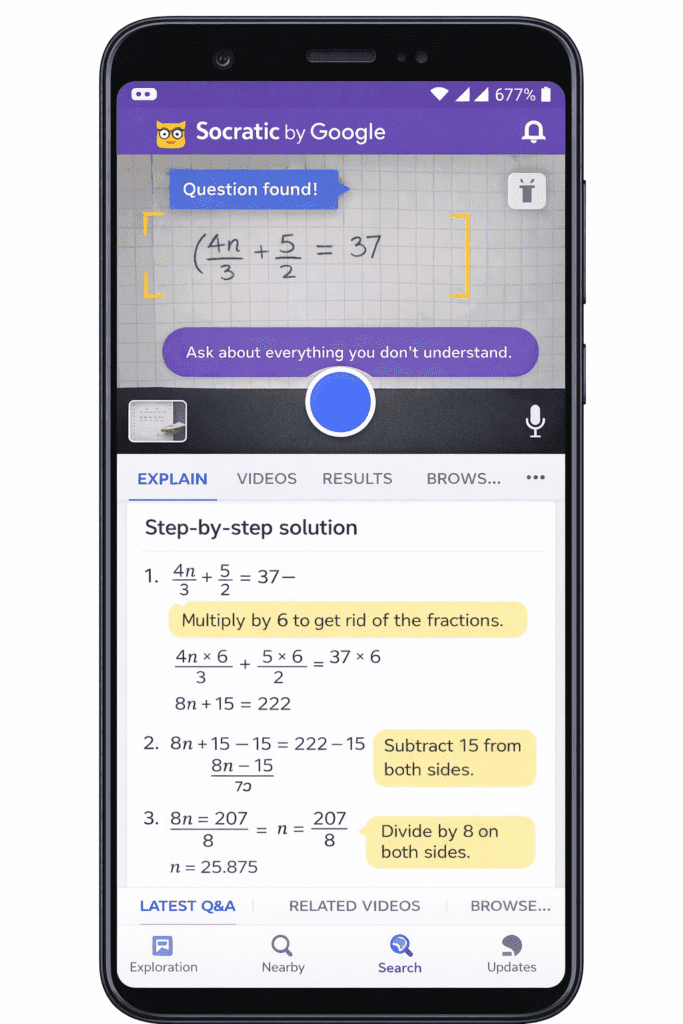
AI tutoring apps help students practise and learn outside of school. These apps do not just give answers — they ask follow-up questions to check if the student really understands. Tools like Khan Academy’s Khanmigo and Socratic by Google are used by millions of students worldwide.
Automatic grading
Teachers spend hours marking tests and assignments. AI grading tools can mark multiple-choice tests instantly. Newer tools can also check short written answers and give basic feedback on essays — saving teachers significant time every week.
Tools like Gradescope and Turnitin are used in many Indian universities and higher secondary schools.
Adaptive learning
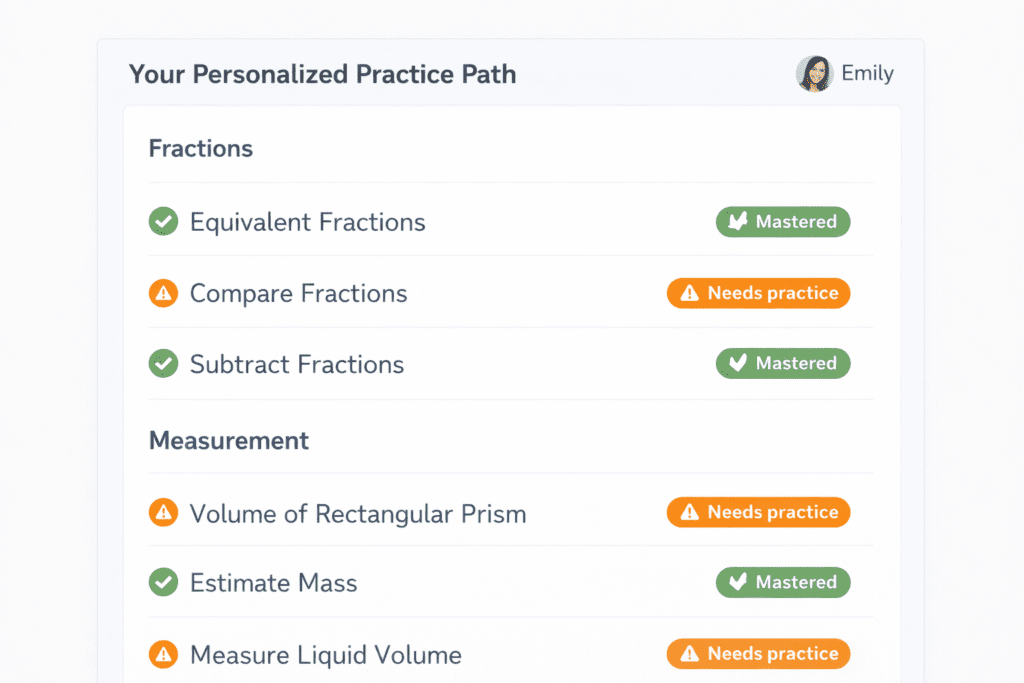
Adaptive learning platforms change the difficulty and type of content based on how a student is doing. If a student keeps getting a topic wrong, the platform gives more practice on that topic. If they master it quickly, the platform moves them forward. Every student gets a slightly different learning path.
Saving teachers time on admin work
AI tools can write first drafts of lesson plans, generate report card comments, send parent communication, and track attendance automatically. Teachers using these tools report saving 3 to 5 hours every week — time they can spend with students instead.
→ AI tools for academic writing and research
How AI is helping teachers and students
For teachers
The biggest change AI brings for teachers is better information before the lesson starts.
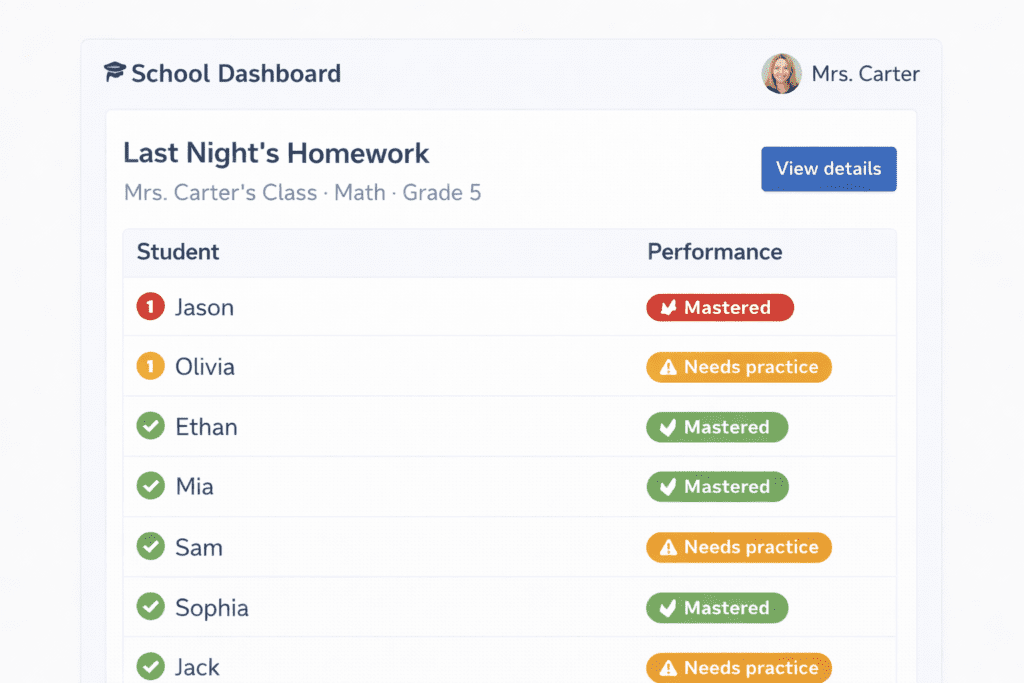
AI-powered school software can show a teacher exactly which students struggled with last night’s homework — and which specific questions caused the most difficulty. The teacher walks into class already knowing where to focus.
Without AI, a teacher might not discover that half the class misunderstood a concept until the test. With AI, they know the morning after the homework was due.
- Teachers can plan better lessons because they see exactly where students are struggling
- Automated grading saves hours of marking time every week
- AI tools help write lesson plans, parent emails, and reports faster
- New teachers get structured support that experienced teachers have built up over years
For students
The biggest change for students is support that is available any time.
Learning questions do not only come up during school hours. A student revising for exams at 10 pm can ask an AI tutor for help and get an explanation immediately — without having to wait until the next day.
- Get help with homework at any hour, not just during school
- Practice at your own pace — move faster if you are ahead, slower if you need more time
- Get explanations that match your specific confusion, not a general class explanation
- Students who feel embarrassed asking in class can ask the AI privately
Best AI tools for teachers and students in 2026
| Khan Academy Khanmigo | Free AI tutor built into Khan Academy. Instead of giving direct answers, it guides students through problems with questions — helping them think, not just copy. Also helps teachers with lesson planning. Works for school subjects from primary to secondary level. |
| Socratic by Google | Free AI tutor built into Khan Academy. Instead of giving direct answers, it guides students through problems with questions — helping them think, not just copy. Also helps teachers with lesson planning. Works for school subjects from primary to secondary level. |
| Gradescope | Grading tool for teachers. Groups similar student answers together so teachers can mark them in batches — much faster than marking one by one. Used in many Indian universities and IITs. Especially useful for science and maths assessments. |
| Turnitin + AI feedback | Most schools know Turnitin for checking plagiarism. It now also gives students feedback on their writing before they submit — pointing out weak arguments, unclear sentences, and structural problems. Used in CBSE, ICSE, and university-level institutions. |
| MagicSchool AI | Saves teachers time on paperwork. Types of tasks it handles: lesson plans, rubrics, parent emails, report card comments, quiz questions. Teachers describe saving 3 to 7 hours per week — time they use for actual teaching instead. |
| Diffit | Takes any topic or article and rewrites it at different reading levels automatically. Useful when a class has students reading at very different levels — the teacher enters one topic and gets versions for beginners, intermediate learners, and advanced readers. |
| Curipod | Creates interactive lessons and activities from a topic description in under two minutes. Good for teachers who want engaging digital lessons without spending hours building them from scratch. |
Personalised learning with AI — what it actually means
Personalised learning means every student gets content that matches their specific level and needs — not the same lesson delivered the same way to everyone.
AI makes this possible at scale. A teacher cannot give 40 students 40 different worksheets. An AI platform can — automatically, based on what it has observed about each student.
Real classroom example
Two Class 8 students are both studying fractions on an adaptive maths platform. Student A is good at adding fractions but makes errors with division. Student B is the opposite. The platform automatically gives Student A more division practice with extra help, and gives Student B more addition practice with visual diagrams. They sit next to each other in the same classroom but are doing completely different practice — each student getting exactly what they need.
According to the OECD, well-implemented adaptive learning systems help struggling students catch up faster than traditional whole-class teaching. The reason is simple: the support is immediate and targeted to the exact problem — not a general review of everything.
Personalised learning only works if the student actually engages with the platform. AI can identify the gap and provide targeted practice. Making the student sit down and do it — that is still a human challenge no algorithm has solved.
Ethical use of AI in education — what everyone should know
AI in education brings real benefits — but also real risks. Here are four things students, teachers, and parents need to understand.
1. AI can carry hidden bias
AI systems learn from past data. If that data shows certain groups of students performing less well — because of inequality, not because of ability — the AI may unfairly route those students toward easier content. This can make existing gaps worse, not better. UNESCO has specifically identified bias monitoring as something every school using AI must take seriously.
2. Student data must be protected
AI learning platforms collect a lot of information about each student — every question they answer, every mistake they make, how long they spend on each task. This data belongs to the student and must be kept safe. India’s Digital Personal Data Protection Act 2023 has specific rules about collecting data from children. Schools are responsible for making sure any AI tool they use follows these rules.
3. Academic honesty is a new challenge
AI tools like ChatGPT can write a complete essay in seconds. This creates a genuine question: what does it mean to submit your own work when AI can do most of it for you? Schools and universities are still working out the rules. The honest answer is that there is no single answer yet — policies vary widely between institutions. Students should always check their school’s specific guidelines before using AI for assignments.
4. Learning to use AI responsibly is itself a skill
The World Economic Forum says AI literacy — understanding how AI works, its limits, and how to use it responsibly — is becoming one of the most important skills for young people to develop. This means the goal is not to ban AI from education. The goal is to teach students to use it as a tool that supports their thinking — not as a replacement for it.
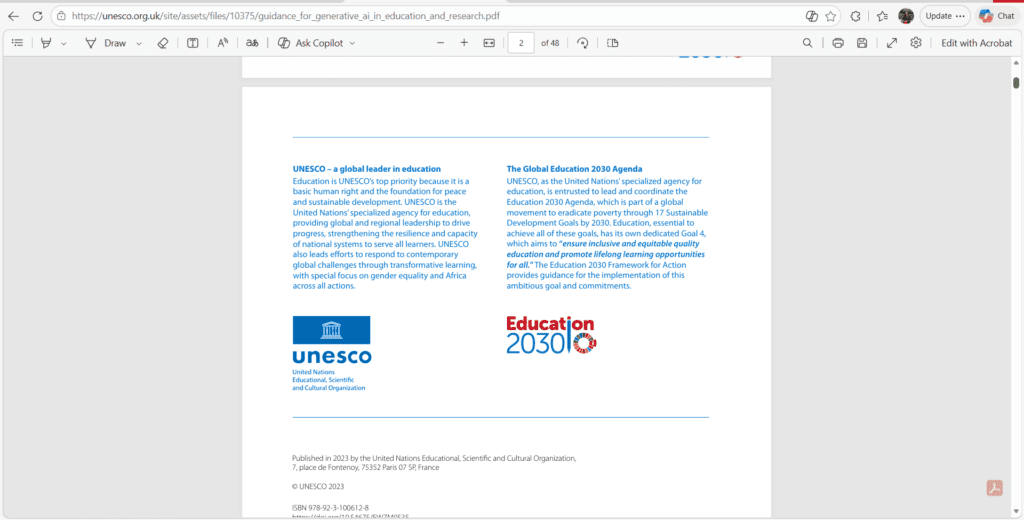
UNESCO’s AI in Education guidance page
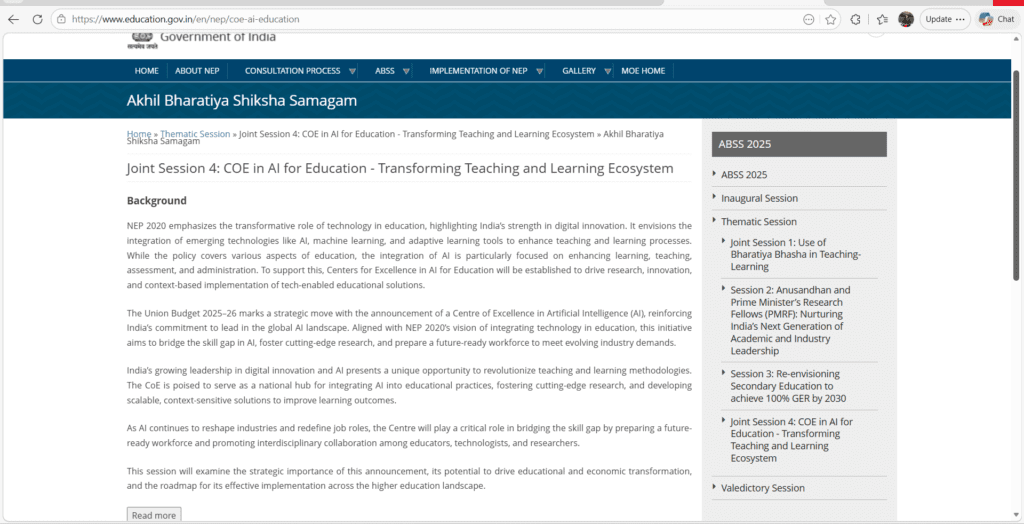
India’s NEP 2020 AI in Education guidance
Benefits and challenges of AI in education
| Benefits | Challenges |
| Every student gets a learning path that fits their level — even in large classes | Many schools in rural India do not have reliable internet or enough devices |
| Students can get help at any time — not just during school hours | Students may start relying on AI instead of trying to think for themselves first |
| Teachers save hours each week on marking and admin — more time for students | AI grading of written work is still not as good as an experienced teacher’s feedback |
| At-risk students can be spotted early, before they fall too far behindAt-risk students can be spotted early, before they fall too far behind | Student data must be carefully protected — not all platforms meet India’s privacy rules |
| Different content levels for different students — AI handles this automatically | If AI reinforces past inequalities in its data, it can make gaps worse, not better |
What comes next — the future of AI in education
The future of AI in education is not about more dramatic technology. It is about how schools, teachers, and governments decide to use what already exists.
AI literacy will become a school subject
Many countries are now making AI literacy a required part of the school curriculum. India’s NEP 2020 includes AI and computational thinking from middle school onwards. By 2028, most secondary school graduates in India should have formal AI training as part of their education.
AI tutors will use voice and images — not just text
Right now, most AI tutoring tools work through typing. In the next few years, students will be able to speak to AI tutors or show them a problem through the phone camera and get a spoken explanation back. This makes AI help accessible for younger students and for students who find typing difficult.
Teachers will focus on what only humans can do
The realistic picture of AI in education is not teachers being replaced. It is teachers spending less time on grading, data entry, and paperwork — and more time on the parts of teaching that only a human can do well: encouraging a struggling student, explaining something in a creative new way, building the trust that makes a student want to learn.
The biggest challenge is equal access
The students who could benefit most from AI education tools are often the ones with least access to them — students in rural areas, students without smartphones at home, schools without reliable electricity. If AI education only helps students who already have advantages, it will make inequality worse. This is the most important challenge for India specifically, and it requires government action — not just market growth.
AI will not transform education on its own. It will transform education in proportion to how thoughtfully teachers, schools, and governments decide to use it. The technology is ready. The decisions about how to use it fairly are still being made.
Frequently asked questions
Q. How is AI being used in schools in 2026?
Schools use AI for personalised learning apps, automatic grading, AI tutors, smart classroom tools, and teacher admin support. The most common uses are adaptive practice platforms for maths and languages, and AI feedback tools for written work in secondary and higher education.
Q. What are the best free AI tools for students?
Socratic by Google (homework help, free), Khan Academy Khanmigo (AI tutoring, free), Diffit (reading levels, free tier), and ChatGPT free tier (research and writing help). All work on mobile, which makes them accessible for most Indian students.
Q. Can AI replace teachers in schools?
No. AI handles data, grading, and practice questions. Teaching needs human judgment, relationships, encouragement, and context — things AI cannot do reliably. The realistic role for AI is supporting teachers, not replacing them. Every education research body — UNESCO, OECD — agrees on this point.
Q. Is using AI for homework cheating?
It depends on how it is used and what your school’s rules say. Using AI to explain a concept you do not understand is generally acceptable. Using AI to write your assignment and submitting it as your own work is academic dishonesty at most institutions. Always check your school’s specific AI policy before using it for assignments.
Q. How does personalised learning with AI work?
AI learning platforms track which questions a student gets right and wrong, and how long they take. From this, the platform builds a picture of each student’s strengths and gaps. It then adjusts what content it shows next — more practice on weak areas, harder challenges in strong areas — for each student individually.
Q. Is AI in education safe for children?
It can be, when used responsibly. India’s DPDPA 2023 protects children’s data. Schools must ensure any AI platform they use follows these rules. Parents can ask their child’s school which AI tools are being used and how student data is protected before giving consent.
Q. Which Indian schools are using AI?
CBSE and ICSE schools in major cities are the most active, often through BYJU’S, Vedantu, and Toppr. IITs and IIMs use Gradescope for AI-assisted grading. Government school adoption is growing through NEP 2020 programmes, though rural schools still have significantly less access than urban ones.
About Author
Dr. Rekha Khandelwal -Academic Content Specialist
Rekha is the founder of AspirixWriters. She has 7+ years of experience in academic writing, research support, and AI-assisted content for education and professional sectors. She works with PhD researchers, academic institutions, and edtech companies across India and internationally. Based in Jaipur, Rajasthan.
- AI Tools for Academic Writing ·
- AI for Small Businesses India ·
- Perplexity AI Review ·
- Best Free AI Writing Tools ·
- AI vs Human Writing
References:
- 1. UNESCO Global Education Monitoring (unesco.org) ·
- 2. OECD Education at a Glance (oecd.org) ·
- 3. NEP 2020 portal (education.gov.in)
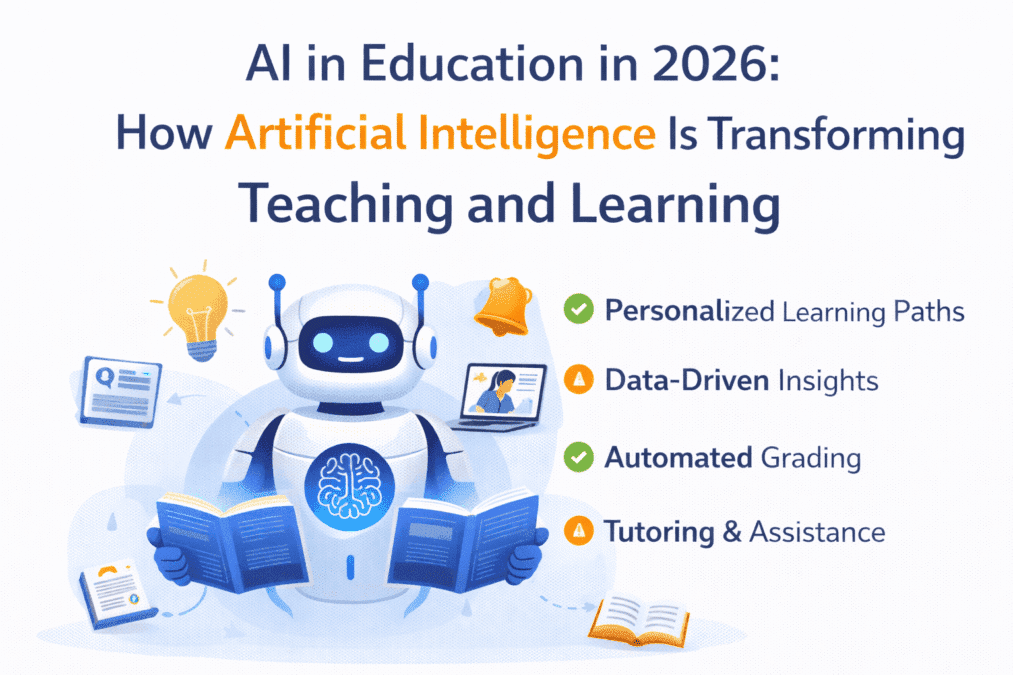
AI in Education in 2026: How Artificial Intelligence Is Transforming Teaching and Learning
Think about a Class 10 student in Jaipur. It is 10 pm. She is stuck…
AI Ethics and Future: Complete Guide to Responsible AI in 2026
AI Ethics and Future Why AI Ethics Matters More Than Ever Think about the last…

AI Research Revolution 2026: Complete PhD Workflow Guide
AI Research Revolution 2026 The complete AI PhD research workflow 2026 is changing how researchers…
15 Best Free AI Tools Every PhD Student Needs in 2026
15 Best Free AI Tools for PhD Students 2026 Finding the best free AI tools…
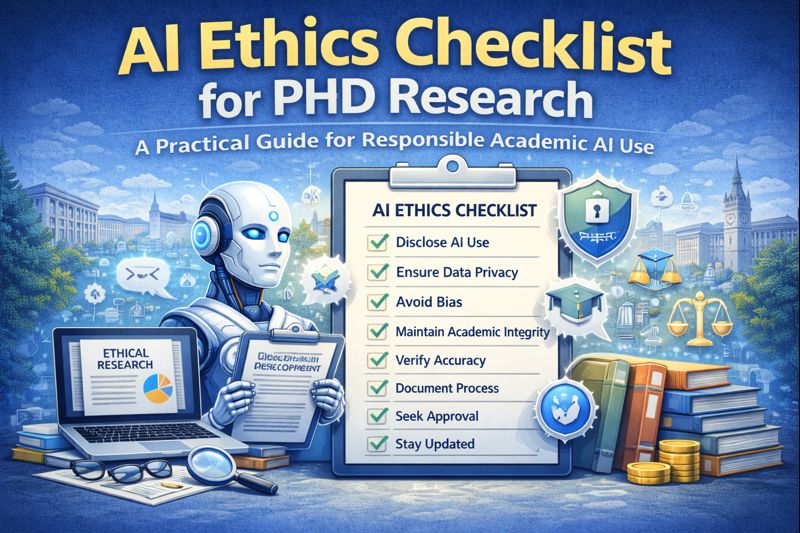
AI Ethics Checklist for PhD Research: A Practical Guide
AI Ethics Checklist for PhD Research 10-Point Compliance Checklist 2026 Everything you need to use…
How to Do a Literature Review Using AI Tools
Imagine opening your research database and seeing hundreds of papers on your topic. Instead of…